Platform search strategies
Introduction
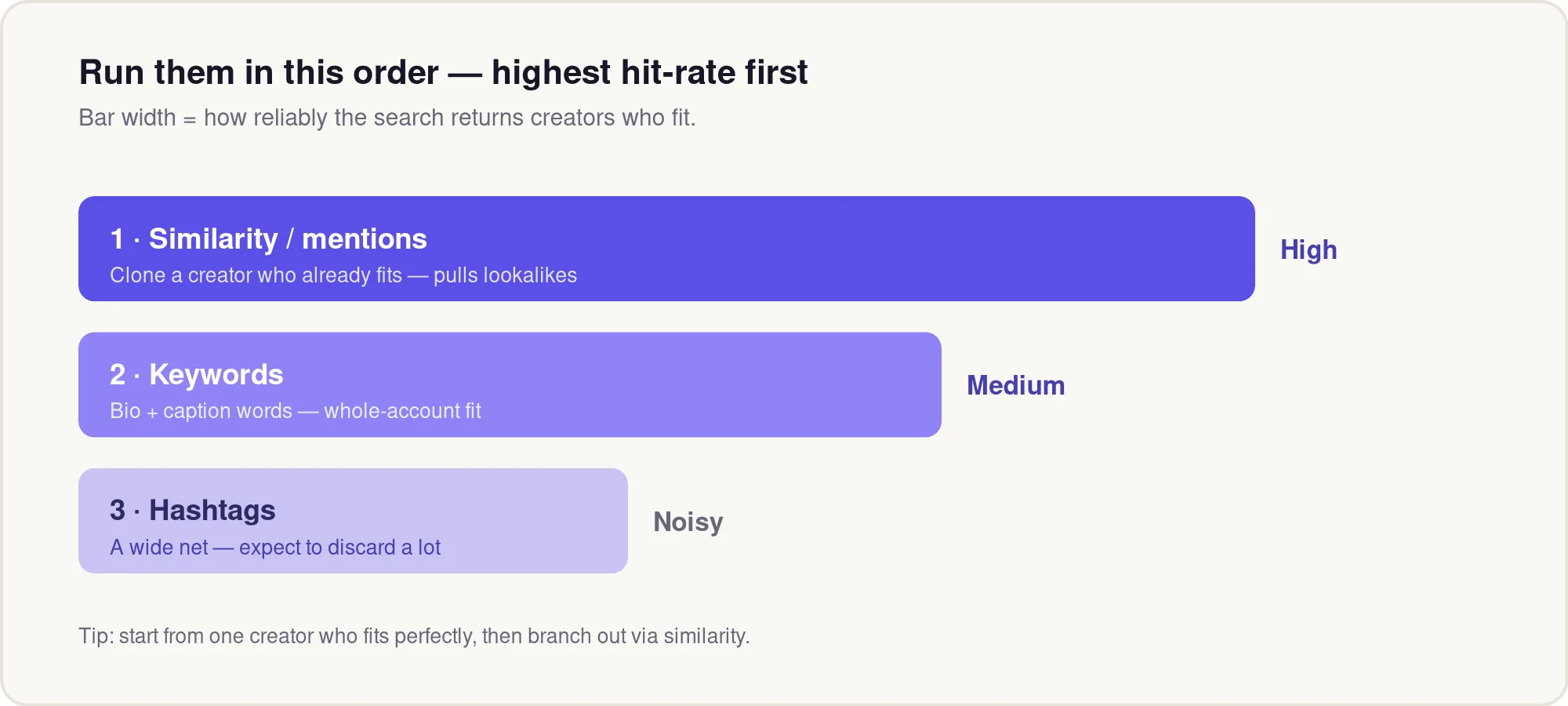
Once you're searching on a platform, three search types do most of the work: similarity, keywords, and hashtags. They aren't equal — they differ a lot in hit-rate (the share of results that are actually a fit). This topic covers what each one is best at and the order to run them in.
Why this matters
Running the right search first fills your list with people who already fit, so you spend less time wading through mismatches. Lead with the noisiest source and you'll burn an hour discarding off-target profiles before you find one good one. Order is the cheapest optimization in Discovery.
Core concepts
- Similarity / mentions — give the platform one creator who fits and it returns lookalikes by audience and content. Highest hit-rate, because you're cloning a profile that already works.
- Keywords — search the words creators put in their bio and captions. Bio keywords find people whose whole account is your niche, not just one stray post.
- Hashtags — the widest, noisiest net; useful for coverage but expect to discard most results.
Step-by-step process
- Find one creator who fits perfectly, then run a similarity search off them.
- Pull their best bio keyword and run a keyword search.
- Take the top niche hashtag and skim recent and top posts.
- Drop every candidate into the tracker as you go — don't stop to judge.
Real-world examples
Example: a coffee brand seeds similarity off one barista-creator and gets 18 strong lookalikes in minutes. A keyword search for "home barista" adds 12 more. The hashtag #coffeetok surfaces 50 results, of which only 7 survive a skim — useful, but clearly the lowest-yield of the three.
Common mistakes
- Leading with hashtags (the noisiest source) instead of similarity.
- Treating one stray on-topic post as proof of fit.
- Re-searching the same keyword variations instead of seeding new similarity searches off your best finds.
Best practices
- Every time you find a great creator, run a fresh similarity search off them — quality compounds.
- Keep a short list of your best bio keywords for the niche; reuse them across campaigns.
- Use hashtags last, for coverage, not as your primary source.
Key takeaways
- Similarity > keywords > hashtags on hit-rate — search in that order.
- Seed new similarity searches off your best finds.
- Use hashtags for coverage, expecting to discard most.
One source deserves its own page: the creators your competitors already pay.