Choosing Your Influencer Program
Overview
Introduction
An "influencer program" is the structure of how you work with creators, not a single campaign. It defines what you give (product, cash, commission), what you get (a post, ongoing content, sales), and how the relationship runs over time.
This page walks through the main program types with examples, a simple way to choose the right one for where your product and budget are today, the best practices that keep it from going sideways, copy-paste prompts to pressure-test your choice, and what actually tends to work for small and medium brands.
By the end, you'll be able to name the program model that fits your stage and defend why.
The Main Types of Influencer Programs
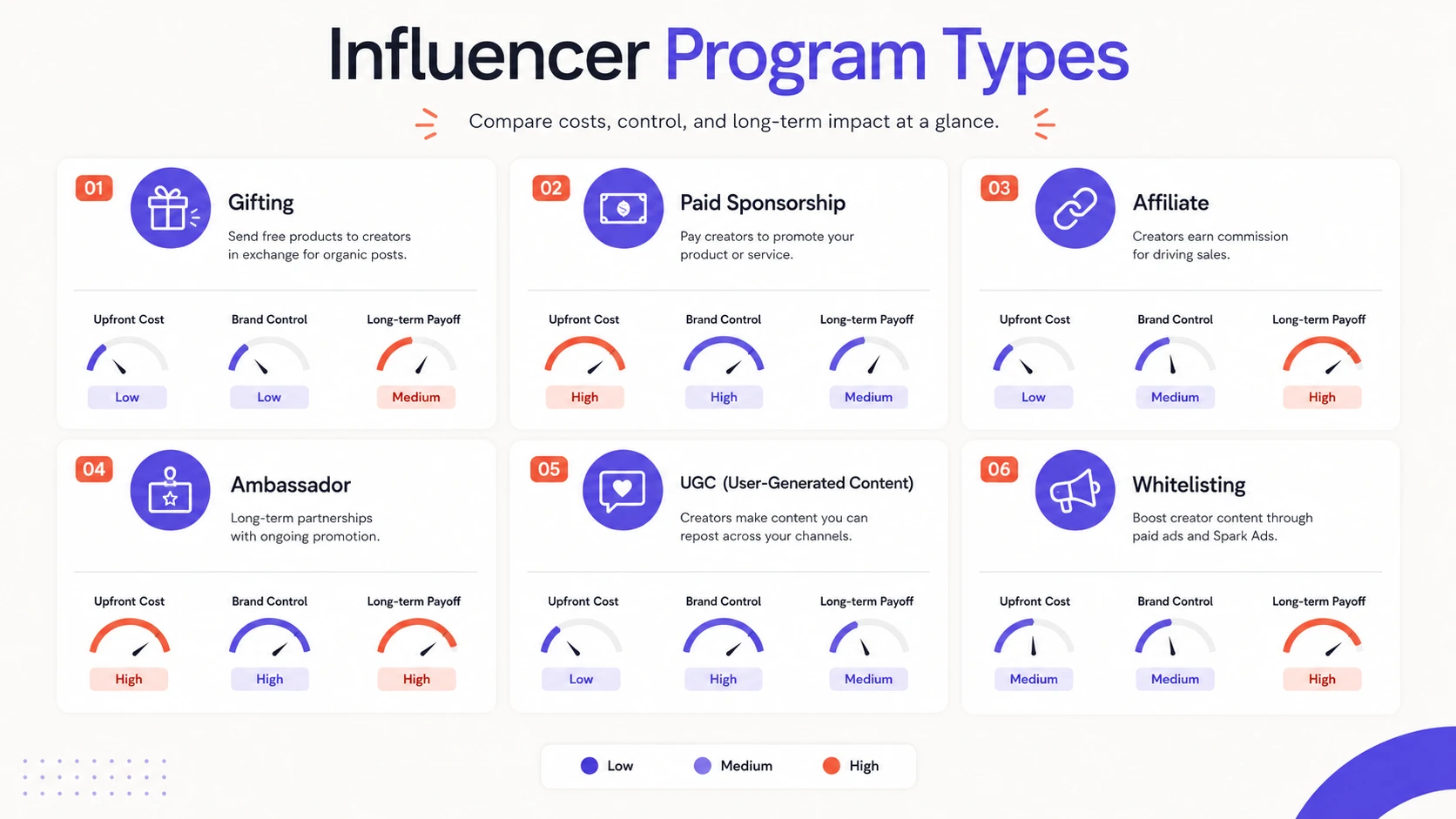
There are six models worth knowing. Most SMB brands run one or two at a time, not all six.
1. Product gifting/seeding — You send a free product and hope for an organic post. No payment.
- Best for: low budget, physical products with good margins, building early social proof.
- Example: A skincare brand ships samples to 50 micro-creators (5k–30k followers). 12 posts unprompted; the brand reshares all of them.
- Reality check: Post rates are low (often 10–30%), and you don't control timing or messaging. Volume game.
2. Paid sponsorships (one-off) — You pay a flat fee for a set deliverable (a Reel, a Story set, a TikTok).
- Best for: a specific launch or moment when you need reach on a date you control.
- Example: Pay a creator $500 for one Reel plus two Stories, posted during launch week.
- Reality check: Predictable and controllable, but spending disappears after the post. No compounding.
3. Affiliate/commission programs — Creators earn a cut of sales they drive via a unique code or link.
- Best for: products with proven conversion and healthy margin; performance-minded brands with little upfront cash.
- Example: A fashion label gives creators a 15% commission plus a 10% audience discount code and pays only on sales.
- Reality check: Low risk on spend, but top creators won't work on commission only until you're a known brand. Often paired with a small flat fee.
4. Ambassador / long-term programs — An ongoing relationship: creators post on a regular cadence in exchange for product, retainer, commission, or a mix.
- Best for: brands past the testing phase that want a consistent, authentic presence.
- Example: A fitness brand signs 10 ambassadors for 3 months: monthly a product, $200/month, plus affiliate commission, for two posts a month each.
- Reality check: The most authentic-feeling and highest-trust model, but it needs real relationship management.
5. UGC creator programs — You pay creators to make content you own and use yourself (on your channels and ads). Their follower count barely matters.
- Best for: brands that need a steady stream of native-feeling content for paid ads.
- Example: Pay a UGC creator $150 per TikTok-style video for three videos; you run them as Spark Ads from your own account.
- Reality check: This is content production, not reach. Often the best ROI for early DTC brands.
6. Whitelisting / partnership ads (Spark Ads) — You run paid ads through the creator's handle, combining their authenticity with your targeting and budget.
- Best for: a creator post that's already performing organically, and you want to scale it.
- Example: A post hits a 6% engagement rate; you get whitelisting rights and put $1,000 of ad spend behind it from the creator's account.
- Reality check: Powerful amplifier, but requires the creator to grant ad permissions and have a working ads setup.
How to Choose the Right Program
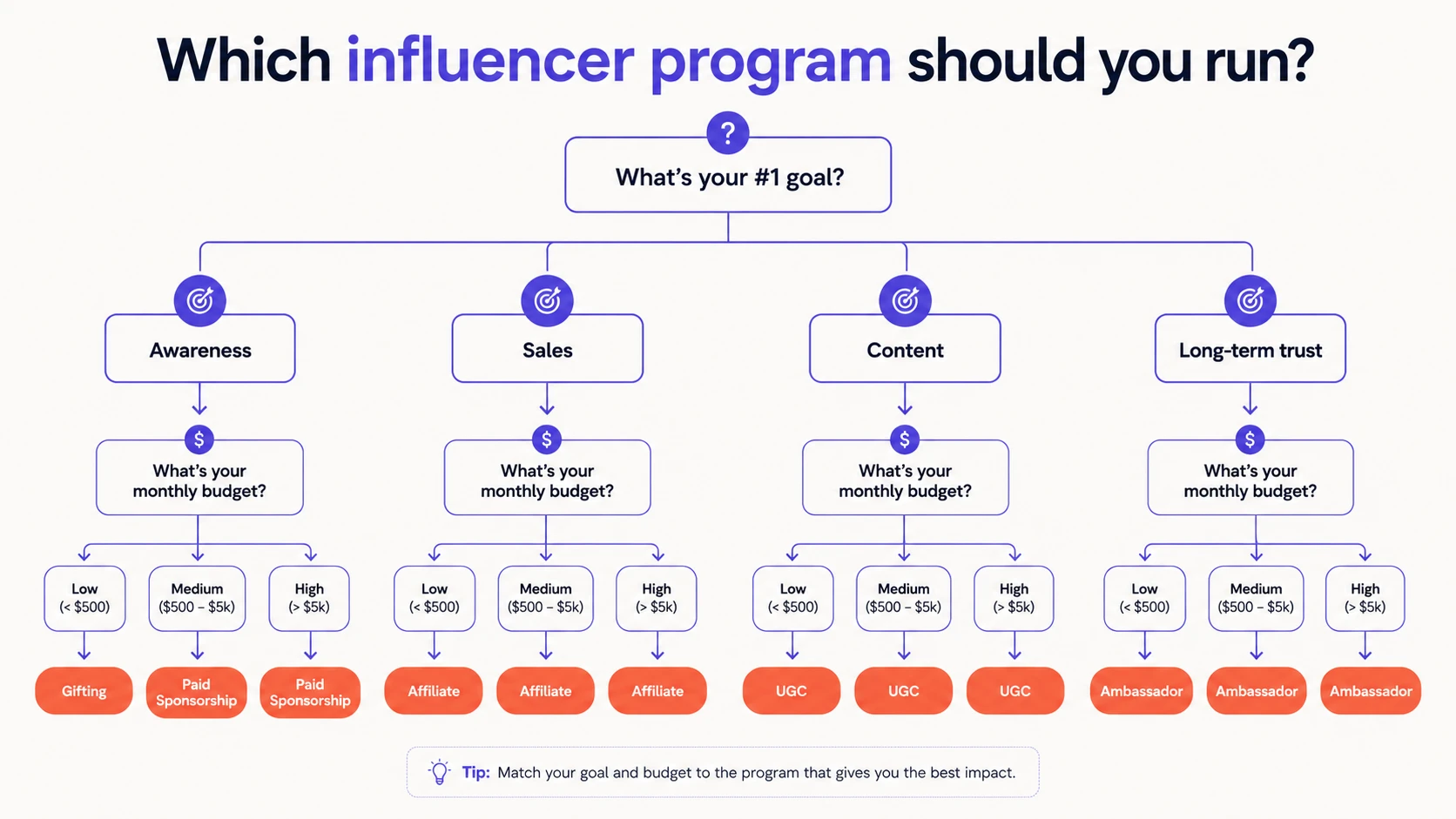
Don't start from the program. Start from four inputs, then the program picks itself.
1. Your goal — Be honest about the single most important outcome:
- Awareness/reach → Paid sponsorships, whitelisting.
- Sales now → Affiliate, whitelisting.
- Content for your own ads → UGC program.
- Long-term trust and presence → Ambassadors, gifting at scale.
2. Your budget — Match the model to what you can spend without flinching:
- Under $500/month → Gifting + a small affiliate program.
- $500–$2,000/month → UGC program or a handful of paid micro-creator posts.
- $2,000+/month → Paid sponsorships, ambassadors, whitelisting layered on top.
3. Your product and margin — High-margin, repeat-purchase products can fund commission and gifting easily. Low-margin or considered-purchase products lean toward UGC and paid posts where you control the message.
4. Your team capacity — Be realistic about hours. Gifting and ambassadors are relationship-heavy. Affiliate and UGC are lighter to run once set up. A one-person marketing team should not launch a 30-person ambassador program in month one.
Here's the quick version as a table:
| If your priority is… | And budget is… | Start with |
|---|---|---|
| Social proof, low cost | Under $500/mo | Gifting + small affiliate |
| Content for paid ads | $500–$2k/mo | UGC creator program |
| Reach on a launch date | $1k+/mo | Paid sponsorships |
| Sales with low upfront risk | Any | Affiliate |
| Consistent long-term presence | $2k+/mo | Ambassador program |
| Scaling a post that's working | $1k+ ad budget | Whitelisting |
A practical sequence for most SMBs: start with gifting + UGC to learn what content converts, layer in affiliate to capture sales, then graduate winners into ambassadors and whitelisting. You rarely need to commit to one model forever.
Best Practices
A few rules keep any program from quietly failing:
- Run one or two models well, not six poorly — Focus beats spread when your team is lean.
- Always get usage rights, even on gifting — A clause letting you repost and run ads from the content is often worth more than the post itself. Cheap to ask for upfront, expensive to chase later.
- Track everything with codes and links from day one — Unique discount codes or UTM links per creator are the only way you'll know which program actually paid off.
- Set deliverables in writing — Even a one-line brief: what to post, when, what to mention, what to avoid. Ambiguity is where collaborations go cold.
- Test small, then scale the winners — Run 5–10 creators in a model before committing budget. Move spend toward whatever produced sales or content you can reuse.
- Pay fairly and on time — Your reputation among creators is itself a growth channel; they talk to each other.
- Pick creators on fit and real engagement, not follower count — A 15k-follower creator with an engaged, on-target audience usually beats a 200k account with hollow reach. Tools like Impulze's free SocialIQ Chrome extension let you check a creator's real engagement and audience right on their profile before you commit to any program.
Prompts to Find Your Right Program
Paste these into ChatGPT, Claude, or any assistant and fill in the brackets. They're built to force a clear recommendation, not vague options.
You are an influencer marketing strategist for small and medium brands.

My brand: [what you sell, price point, margin]
My #1 goal for the next 90 days: [awareness / sales / content for ads / long-term presence]
Monthly budget I'm comfortable with: [amount]
My team: [how many people, hours/week on this]
What I've tried before (if anything): [notes]

Recommend ONE primary influencer program model (gifting, paid sponsorship,
affiliate, ambassador, UGC, or whitelisting) and one optional secondary model.
For each: explain why it fits my inputs, the rough cost to run it, what to
measure, and the first three steps to launch it this month.
Act as a skeptical CFO reviewing my influencer plan.

I want to run a [program type] program with a budget of [amount] to achieve
[goal]. Here's my product and margin: [details].

Pressure-test this. Where am I likely to waste money? What's a more
cost-effective model given these numbers? Give me the break-even math:
how many sales or how much reused content I need for this to pay off.
Help me write the offer for my [program type] program.

Brand: [name + what you sell]
What I'll give the creator: [product / fee / commission / mix]
What I need in return: [deliverables, timing, usage rights]

Write a short, friendly outreach message and a one-paragraph program brief
I can send to creators. Keep it human, not corporate.
What Works for SMBs (Case-Study Patterns)
Specific brand numbers vary, but the patterns below show up again and again in influencer marketing for small and medium brands. Treat them as illustrative of how the models behave, not as guaranteed results.
Pattern 1 — UGC before reach
Early DTC brands that started by paying a handful of UGC creators for ad content (not for their following) consistently found their best-performing paid ads came from that content. The lesson: when budget is tight, buy content you own before you buy someone else's audience.
Pattern 2 — Affiliate as the patient engine
Brands that layered an always-on affiliate program under their paid posts turned one-off collaborations into a compounding sales channel. Creators who were paid once kept posting because the code kept earning. Low upfront cost, slow to start, strong over months.
Pattern 3 — Gifting at volume creates the shortlist
Brands that seeded product to 30–50 micro influencers rarely got 50 posts, but the 10–15 who did post (and whose content performed) became the obvious candidates for a paid ambassador program. Gifting doubled as a low-cost audition.
Pattern 4 — Whitelisting rescues spend
Brands that secured influencer whitelisting rights up front could put ad budget behind the occasional organic post that overperformed, squeezing far more out of a single collaboration than the original post fee.
The through-line: small brands win by starting cheap, measuring honestly, and graduating only what works into bigger commitments. Choosing the right program is what makes that ladder possible.
Key Takeaways
- An influencer program is a structure, not a campaign. Pick the model first.
- The six models — gifting, paid sponsorship, affiliate, ambassador, UGC, whitelisting — trade off cost, control, and payoff differently.
- Choose from four inputs: goal, budget, product/margin, and team capacity. Don't start from the tactic.
- For most SMBs: start with gifting + UGC, add affiliate for sales, then graduate winners into ambassadors and whitelisting.
- Get usage rights and per-creator tracking from day one, no matter the model.
- Test small, pay fairly, and scale only the winners.
Next up: with a program model chosen, it's time to actually find the creators who fit your profile.