Setting your campaign goal
Introduction
Most influencer marketing fails before any outreach happens, because nobody decided what it was actually for. The team picks creators, sends product, and only later asks "did that work?" — with no way to answer. This topic fixes that by making you set one measurable goal before you spend a cent.
The goal you set here quietly decides everything downstream: who you pick, what you pay, which deal you offer, and how you measure success. Get it right and the rest of the playbook has a clear target; skip it and every later decision is a guess.
Why this matters
A goal you can't check later isn't a goal — it's a hope. "Grow our brand" and "get more engagement" feel like goals but can't tell a win from a waste. A number with a deadline can, and that's what lets you learn from one campaign and improve the next.
One goal per campaign also keeps you focused. Chase sales, content, and awareness at once and you optimise for none of them — the creator who drives orders is rarely the one who makes the best ad footage or the widest reach.
Core concepts
There are three primary goal types. Pick one as the campaign's headline:
- Sales — trackable first orders or trials. Best when you have a clear offer and a way to attribute (codes, links).
- Content — creator videos you can reuse as paid ads or on your own channels. Best when your ad creative is stale.
- Reach — qualified views in a new audience. Best for launches or entering a new market.
Whichever you choose, write it as one sentence with a number and a deadline. "Attribution" just means a way to trace a result back to a creator — a discount code, a UTM link, or an affiliate link.
Step-by-step process
- Choose one primary goal: sales, content, or reach.
- Write it as a number with a deadline (e.g. "300 first orders attributable to creators in 60 days").
- Sanity-check it's actually checkable — do you have the code/link/report to measure it?
- Get everyone who touches the campaign to agree this is the goal before you start.
Real-world examples
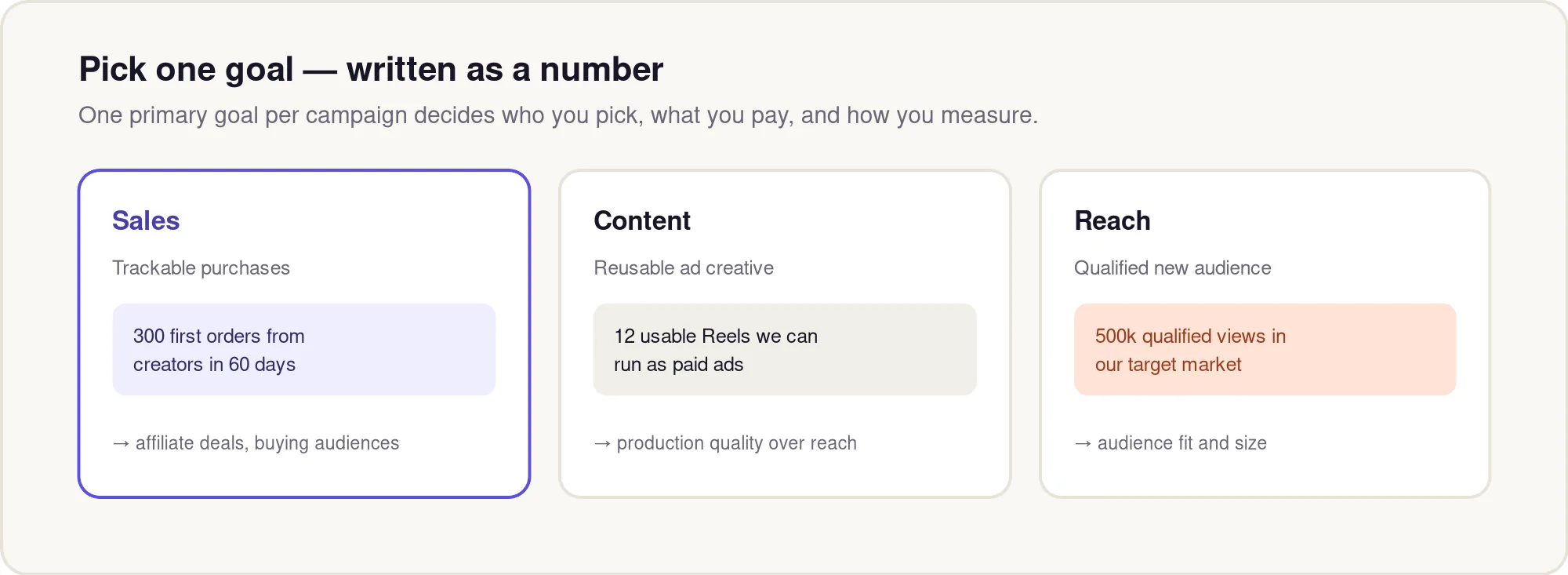
Example: a skincare brand picks "200 first orders in 8 weeks via creator codes." That single number immediately points them at affiliate deals and creators with buying-intent audiences — not the biggest accounts. A second brand picks "10 usable Reels for paid ads," which sends them toward production quality instead of follower count.
Common mistakes
- Vague goals like "grow our brand" that can't be measured.
- Chasing sales, content, and reach in one campaign.
- Setting a number you have no way to actually track.
Best practices
- Keep the goal to one sentence, pinned where the whole team can see it.
- Tie the metric to revenue where you can — it's the easiest number to defend later.
- Set a realistic deadline (6–8 weeks for a first program) so you can actually read results.
Key takeaways
- One measurable goal per campaign — sales, content, or reach.
- Write it as a number with a deadline.
- Confirm you can actually track it before you start.
With the goal set, size the budget to it.