Ensuring brand fit
Introduction
Vetting starts here, and the first check isn't a number — it's fit. Brand fit means two things line up: the creator's audience looks like your buyer, and their content is a place your brand belongs. A creator can have flawless engagement and still be the wrong creator if their followers can't buy from you or their feed would make your product look out of place.
By the end of this topic you'll be able to run a fast fit check on any candidate before you spend a minute on their stats — and confidently drop the ones that don't fit, even when the numbers are tempting. Fit is a gate: clear it first, then move on to the profile checks in the next topic.
Why this matters
Fit is the cheapest filter you have and the most expensive one to skip. If the audience or the values don't match, even great content converts badly, because you're paying to put your product in front of people who were never going to buy. A 4% engagement rate on the wrong audience is worse than a 2% rate on exactly the right one.
Getting fit wrong also costs more than money. A creator whose tone clashes with your brand, or whose back catalogue includes posts you'd rather not sit beside, can do real reputational damage for the price of one paid post. Checking fit up front protects both your budget and your brand, and it's the difference between a campaign that compounds and one you quietly write off.
Core concepts
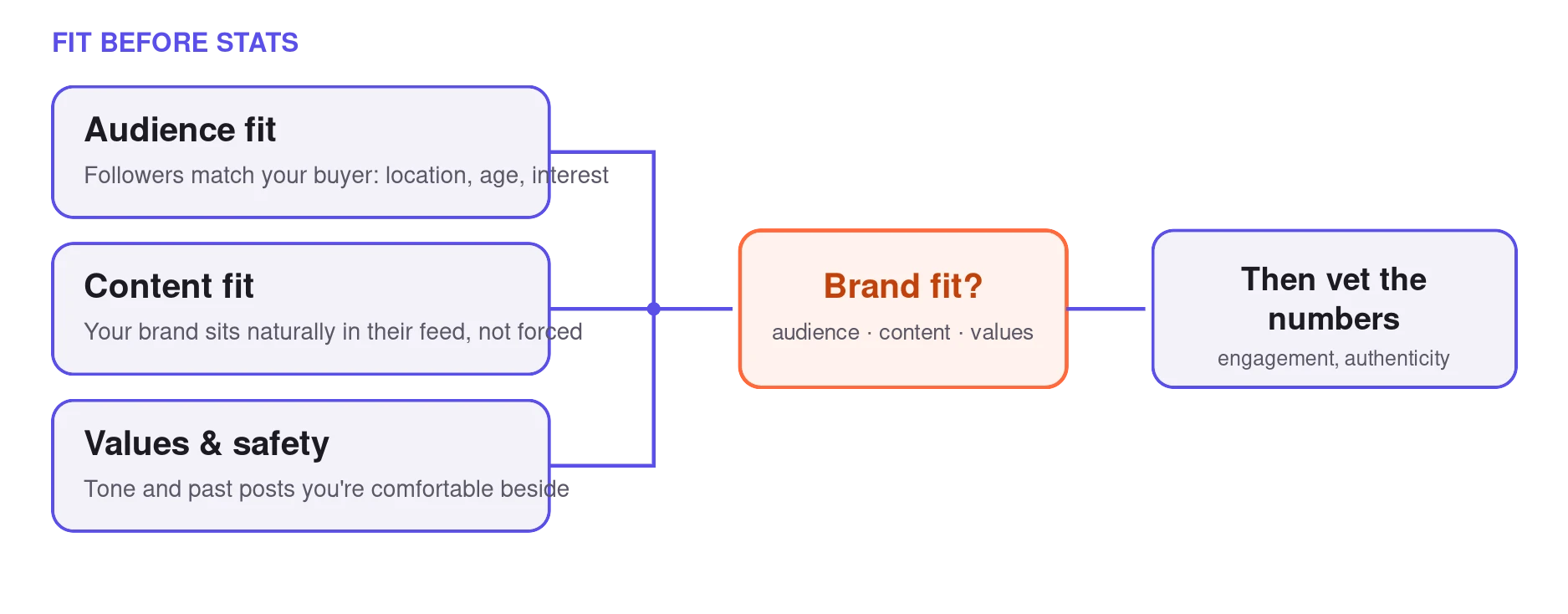
Brand fit has three dimensions. Check them in this order, because each is faster to judge than the last is to fix.
- Audience fit — do their followers actually match your buyer? The three that matter most are location (are they in a market you sell to?), age range, and the core interest that overlaps your product. A creator with a huge but mostly overseas audience can't drive sales you can fulfil.
- Content fit — would your brand sit naturally in this feed, or stick out? Look at the format (do they make the kind of content that sells your product — demos, reviews, lifestyle?), the production quality, and the overall aesthetic. If you can picture your product in their next three posts without it feeling forced, that's content fit.
- Values and brand safety — is this someone you're comfortable being associated with? Scan their recent posts and tone for anything off-brand or risky. This isn't about policing opinions; it's about avoiding a partner whose feed would make your customers wince.
Two terms worth pinning down. Audience fit is about who's watching, not how many. Brand safety is the practice of making sure a partner's content won't expose your brand to controversy or association you didn't sign up for.
Step-by-step process
Run this as a two-to-three minute pass per candidate, before any deep stats.
- Open the profile and read the bio and last nine posts. You're building a quick gut read of who this is and who they're talking to.
- Judge audience fit. Check stated or visible location signals, the age the content speaks to, and whether the niche overlaps your buyer. If a creator's audience location isn't obvious from the content, note it as something to confirm with real audience data in the next topic (the profile checks).
- Judge content fit. Ask the one question that matters: would my product look at home in this feed, in this person's voice? If yes, it fits. If you'd have to bend the brand to make it work, it doesn't.
- Scan values and safety. Skim for tone and any past content that would be a problem to stand beside. One pass is enough to catch the obvious risks.
- Mark a fit verdict in your tracker — fit / borderline / no — and a one-line reason. Only the fit and borderline creators move on to the number checks.
Keep the ideal-creator profile you wrote back in Strategy open while you do this; it's the yardstick that keeps "fit" objective instead of a vibe.
Real-world examples
Example 1 — strong stats, wrong audience. A US skincare brand finds a creator with a 5% engagement rate and beautiful routine videos. On the fit pass, though, roughly 70% of the audience is overseas. The content and values fit perfectly, but the audience doesn't — the reach can't convert into orders the brand can fulfil, so it's a no. Without the fit check, those great-looking stats would have pulled them straight into outreach.
Example 2 — modest stats, perfect fit. A regional coffee brand looks at a 6k-follower local creator with an unremarkable 3% engagement rate. But the audience is concentrated in the brand's own city, the feed is full of café and home-brewing content, and the tone is warm and on-brand. That's three-for-three on fit. They keep them, and the creator goes on to drive more in-store visits than a larger account would have.
Example 3 — a values flag. A family-products brand likes a creator's audience and content, but a scan of recent posts turns up repeated content that clashes with the brand's wholesome positioning. Audience and content fit; values don't. They pass — the association risk isn't worth it.
Common mistakes
- Judging on follower count before fit. A big account with the wrong audience is worse than a small one with the right audience. Size is not fit.
- Ignoring where the audience actually lives. Reach in a market you can't sell to is reach you're paying for and can't use.
- Forcing a brand into a feed it doesn't suit. If you have to contort your product to belong there, the content will read as an ad and convert like one.
- Skipping the values scan. It takes thirty seconds and it's the check that prevents the campaigns you most regret.
Best practices
- Do fit before stats, every time. It's faster and it stops impressive numbers from biasing your judgement.
- Use your ideal-creator profile as the rubric. Fit means fit to your buyer, defined in advance — not a general sense of "good creator."
- Write the reason, not just the verdict. "No — audience 70% overseas" is reusable; a bare "no" means you'll re-research them later.
- When fit is borderline, let the numbers break the tie. Borderline-fit creators are exactly the ones where the profile checks earn their keep.
Key takeaways
- Fit comes before stats: audience, content, then values and safety.
- Audience fit is about who's watching (location, age, interest), not how many.
- If your brand would feel forced in the feed, it's not content fit.
- A thirty-second values scan prevents the partnerships you'd most regret.
- Record a fit verdict and a one-line reason; only fit and borderline creators move on.
Fit confirmed, it's time to look under the hood — next, the 60-second profile checks that catch fake reach before you spend.